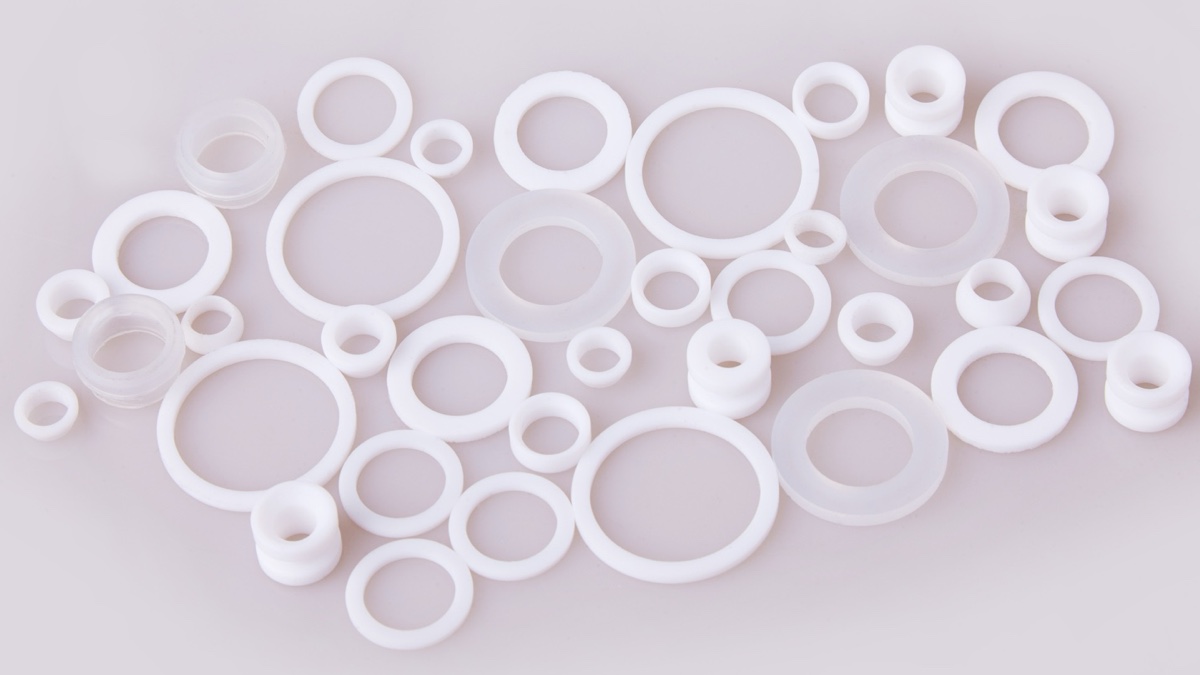
Are silicone O-rings the right seal for your application? Silicone handles extreme heat and cold better than most elastomers. As a result, silicone O-rings are a common choice in medical devices, food processing equipment, electronics, and outdoor equipment.
However, silicone is not a universal answer. It has clear limits with fuels, oils, abrasion, and high-pressure steam. Therefore, you should understand its properties, limitations, and compatibility before you specify it. In addition, if you work in the medical field, you’ll need to know how medical-grade silicone differs from standard silicone.
This guide walks through:
- Key properties of silicone (VMQ) and Marco’s silicone compounds
- Temperature range, advantages, and limitations
- Common applications by industry
- The difference between medical-grade and standard silicone O-rings
- How silicone compares to Viton®, EPDM, Buna-N, and FFKM
- Chemical compatibility, FDA requirements, and selection tips
Quick Reference: Silicone O-Rings at a Glance
| Property | Typical Value |
|---|---|
| Material | Silicone rubber (VMQ, also called PVMQ) |
| Standard temperature range | -65 °F to +400 °F (-54 °C to +204 °C) |
| Specialty grade range | -103 °F to +500 °F (-75 °C to +260 °C) |
| Common hardness | 70 Shore A standard; softer and harder grades available |
| Compliance options | FDA 21 CFR 177.2600, USP Class VI, 3-A, NSF 51 |
| Best with | Dry heat, wide temperature swings, ozone, UV, water, animal and vegetable oils |
| Avoid | Petroleum oils and fuels, ketones, acids, alkalis, brake fluids, abrasion, steam over 250 °F |
Use this table as a starting point. Then confirm the details below for your specific application.
What Are Silicone O-Rings?
Silicone O-rings, often called VMQ O-rings, are seals made from silicone rubber elastomers. VMQ is the ASTM designation for silicone materials used in sealing. In fact, the term silicone covers a large group of materials in which vinyl-methyl-silicone (VMQ) is often the central ingredient.
Unlike many traditional elastomers, silicone stays elastic across an exceptionally wide temperature range. For this reason, silicone O-rings work well where seals face extreme heat, freezing temperatures, UV exposure, ozone, and weathering.
Silicone compounds also come in FDA-compliant and medical-grade formulations. As a result, they are a popular choice for sanitary and sensitive applications. Learn more in Marco’s Silicone O-Rings Selection Guide.
Key Properties of Silicone (VMQ) O-Rings
Silicone O-rings combine environmental resistance with temperature stability. Here are the most notable properties.
Excellent Temperature Resistance
Silicone performs well in both high- and low-temperature environments. Standard silicone O-rings typically operate from -65 °F to +400 °F (-54 °C to +204 °C). For example, Marco’s general-purpose S1000 is rated from -75 °F to +400 °F (-59 °C to +204 °C).
Specialized compounds extend beyond these limits. For instance, S1015 reaches +500 °F (+260 °C), and S1043 stays flexible down to -103 °F (-75 °C).
Outstanding Ozone and UV Resistance
Silicone strongly resists ozone, ultraviolet light, oxidation, and weathering. Therefore, it is an excellent material for outdoor and long-term environmental exposure. Ozone resistance matters most in sunlight, near electrical equipment, and in changing atmospheric conditions.
Flexible and Elastic
Silicone stays flexible even in extremely cold temperatures. As a result, the seal remains where other elastomers become brittle. Silicone also shows outstanding flex and fatigue life. In severe environments, choosing the right material is essential to reliable sealing.
Wide Range of Hardness
Silicone is made in a wide range of durometers, from very soft to very hard. Most standard silicone O-rings are 70 Shore A. However, softer grades help in some cases. For example, 40 durometer S1004 seals rough or warped glands and low closure force designs.
Available in Multiple Colors
Silicone doesn’t require carbon black, so it is easy to color. The industry-standard color is rust red or orange. In addition, silicone compounds are commonly available in:
- Red/orange
- Clear/translucent
- White
- Black
- Blue
Color options are especially useful in food processing, medical, and product identification applications.
FDA and Medical Grade Availability
Many silicone compounds comply with FDA 21 CFR 177.2600 for food contact. Others are tested to USP Class VI for medical and pharmaceutical use. See the Medical & Pharma Sealing Guide and the medical-grade section below for details.
Marco’s Silicone O-Ring Compounds
Marco stocks a broad range of silicone compounds. Each one is built for a specific need:
| Compound | Durometer (Shore A) | Color | Temperature Range | Key Feature / Specification |
|---|---|---|---|---|
| S1000 | 70 | Orange | -75 °F to +400 °F (-59 °C to +204 °C) | General purpose; FDA compliant (21 CFR 177.2600) |
| S1004 | 40 | Orange | -75 °F to +400 °F (-59 °C to +204 °C) | Softer grade for rough glands and low closure force |
| S1015 | 70 | Orange | -65 °F to +500 °F (-54 °C to +260 °C) | Higher temperature resistance |
| S1043 | 50 | Orange | -103 °F to +400 °F (-75 °C to +204 °C) | Lower temperature resistance |
| S1020 | 70 | Clear | -65 °F to +400 °F (-54 °C to +204 °C) | Clear-translucent; FDA compliant (21 CFR 177.2600) |
| S1146 | 70 | White | -75 °F to +480 °F (-59 °C to +249 °C) | Medical grade; USP Class VI and FDA; platinum cured |
| S1083 | 70 | Clear | -65 °F to +400 °F (-54 °C to +204 °C) | Medical grade; USP Class VI and FDA; platinum cured |
| S1037 | 70 | Clear | -65 °F to +400 °F (-54 °C to +204 °C) | Medical grade; USP Class VI and FDA; platinum cured; cleanroom manufactured |
| S1081 | 65 | Orange | -65 °F to +350 °F (-54 °C to +177 °C) | EMI/RFI shielding; nickel-coated graphite filled |
Temperature ranges are approximations for dry air service only. Don’t use them as design specifications.
Silicone O-Ring Temperature Range
Temperature resistance is one of the main reasons engineers choose silicone O-rings. In fact, few widely available elastomers stay this flexible across such a wide range.
High-Temperature Performance
Silicone keeps its sealing properties at temperatures where Buna-N O-rings may harden or fail. It is especially strong in dry heat. As a result, silicone suits:
- Heating systems
- Industrial ovens
- Engine compartments
- High-temperature electronics
For the hottest service, consider S1015, rated to +500 °F. However, dry heat and steam are not the same. Standard silicone is not recommended for steam or superheated water above 250 °F.
Low-Temperature Performance
Silicone also excels in extreme cold. It stays flexible at temperatures that cause other elastomers to crack or lose sealing force. Therefore, silicone O-rings are a strong fit for:
- Outdoor equipment
- Refrigeration systems
- Cold-weather machinery
Material selection is especially important for long-term reliability in severe cold. For example, S1043 is rated down to -103 °F (-75 °C).
Keep in mind that published ranges assume dry air. Pressure, media, and thermal cycling all narrow the real-world range. In short, test in your actual operating conditions.
Advantages of Silicone O-Rings
Silicone O-rings offer several benefits that make them a preferred seal across many industries.
Wide Operating Temperature Range
Silicone performs reliably across one of the broadest temperature ranges of any elastomer.
Superior Weather Resistance
Silicone offers excellent resistance to:
- UV exposure
- Ozone
- Oxidation
- Moisture
- Environmental aging
As a result, silicone is one of the best choices for outdoor sealing and long-term environmental exposure. It also resists fungal and biological attack.
Excellent Flexibility
Silicone stays flexible and compressible, even after prolonged exposure to extreme temperatures.
Food and Medical Compatibility
FDA-compliant and medical-grade silicone compounds are available for sanitary applications. In addition, silicone is odorless and non-toxic, so it suits clean, sensitive environments.
Electrical Insulation Properties
Silicone is a good electrical insulator. Therefore, it is common in electrical and electronic applications. Conductive grades also exist. For example, S1081 provides EMI/RFI shielding, and S1173 is a conductive silicone filled with nickel-coated aluminum.
Limitations of Silicone O-Rings
Silicone O-rings offer many advantages. However, they also have limitations you should weigh during material selection.
Poor Abrasion and Tear Resistance
Silicone has relatively low tensile strength and tear resistance compared to Viton® O-rings or polyurethane. For this reason, it is generally not recommended for dynamic applications involving:
- Abrasion
- Friction
- Reciprocating motion
- High mechanical stress
Limited Fuel and Oil Resistance
Silicone performs poorly when exposed to:
- Petroleum oils
- Fuels
- Hydrocarbon solvents
In these environments, Viton® O-rings or Buna-N O-rings are often better suited. If you need silicone’s cold flexibility with fuel resistance, consider fluorosilicone, such as F1001.
Compression Set and Pressure Limits
Silicone generally offers excellent compression set resistance in static, high-heat service. However, its low strength is a concern in some high-pressure or long-term sealing applications. Under heavy load, silicone can extrude or deform faster than stronger elastomers. In those cases, use a harder grade, back-up rings, or another material.
Steam and Gas Permeability
Standard silicone is not recommended for steam or superheated water above 250 °F. In addition, silicone has high gas permeability. Therefore, it may not suit vacuum or tight gas-sealing applications. Lab data is a starting point, not a guarantee.
Common Applications for Silicone O-Rings
Thanks to their temperature stability and environmental resistance, silicone O-rings serve a wide range of industries.
Food Processing Equipment
FDA-compliant silicone O-rings are common in:
- Beverage systems
- Food handling equipment
- Dairy processing
- Packaging machinery
Electronics and Electrical Systems
Silicone’s insulating properties make it useful for:
- Electrical enclosures
- Connectors
- Outdoor lighting
- Electronic sealing systems
For shielding needs, S1081 combines a silicone seal with EMI/RFI protection.
Outdoor and Environmental Equipment
Because of its weather resistance, silicone is often selected for:
- Outdoor machinery
- Solar equipment
- Marine electronics
- Weather-exposed systems
Medical Devices
Medical-grade silicone is frequently used in:
- Diagnostic equipment
- Fluid transfer systems
- Pharmaceutical processing
- Medical instruments
However, “medical grade” means more than a label. The next section explains what sets it apart.
Medical-Grade vs. Standard Silicone O-Rings
What is the difference between medical-grade and standard silicone O-rings? In short, it comes down to testing, purity, and documentation. Both start from the same base polymer. However, medical-grade compounds are tested for biological safety and made under tighter controls. As a result, they cost more, so it pays to know when you need them.
What “Standard” Silicone Means
Standard silicone O-rings are general-purpose compounds. Most are peroxide-cured. For example, Marco’s S1000 is a peroxide-cured, 70 durometer silicone.
Many standard grades also comply with FDA 21 CFR 177.2600 for food contact. In other words, “standard” doesn’t mean unsafe. Instead, it means the compound hasn’t been tested for biological reactivity.
What Makes Silicone O-Rings Medical Grade
“Medical grade” is not a regulatory term on its own. In practice, it usually means the compound has passed USP Class VI testing. Medical-grade silicone O-rings typically differ from standard grades in five ways:
- Biological testing: USP Class VI covers Chapter <87> in vitro testing and Chapter <88> in vivo testing. ISO 10993 may also apply to patient-contact devices.
- Cure system: Many medical grades are platinum-cured. Platinum curing leaves no peroxide by-products, so extractables tend to be lower. However, some peroxide-cured compounds also pass USP Class VI.
- Manufacturing environment: Some medical grades are made and packaged in a cleanroom. For example, S1037 is cleanroom-manufactured.
- Documentation: Device makers often need certificates of compliance and lot traceability. Confirm these requirements before you order.
- Ingredients: Some medical materials are free of animal-derived ingredients (ADI-free).
Medical-Grade vs. Standard Silicone at a Glance
| Factor | Standard Silicone | Medical-Grade Silicone |
|---|---|---|
| Typical compliance | FDA 21 CFR 177.2600 on many grades | FDA 21 CFR 177.2600 plus USP Class VI |
| Biological testing | Usually not tested | USP <87> in vitro and <88> in vivo |
| Cure system | Usually peroxide | Often platinum; some peroxide grades qualify |
| Manufacturing | Commercial | Commercial or cleanroom, with cleanroom packaging options |
| Common colors | Rust red/orange | Clear, white, or blue |
| Cost | Lower | Higher |
| Marco examples | S1000, S1004, S1015, S1043 | S1037, S1083, S1146, S1166 |
Marco’s Medical-Grade Silicone Compounds
Marco offers several USP Class VI silicone options for medical and pharmaceutical work:
S1037: A 70 durometer, clear, platinum-cured silicone. It is FDA and USP Class VI and cleanroom manufactured.
S1083: A 70 durometer, clear, platinum-cured silicone. It is FDA and USP Class VI.
S1146: A 70 durometer, white, platinum-cured silicone rated to +480 °F. It is FDA and USP Class VI, and it costs less than clear grades.
S1166: A 50 durometer, blue silicone that is FDA and USP Class VI, formulated for food and pharmaceutical use.
T1022: A PFA-encapsulated silicone that is FDA, USP Class VI, and 3-A, with added chemical resistance.
Stocked sizes make it easy to start. For example, S1146-121 is an AS568-121 medical-grade O-ring.
Sterilizing Medical-Grade Silicone O-Rings
Silicone handles dry heat sterilization well. It is also used with ethylene oxide, electron beam, and gamma radiation methods. However, steam is harder on silicone. Standard grades aren’t recommended for steam above 250 °F, and repeated high-pressure steam shortens seal life.
For frequent autoclave or steam-in-place cycles, consider peroxide-cured EPDM such as E1080. Alternatively, steam-grade FFKM such as Markez® Z1426 combines steam resistance with USP Class VI purity. Either way, validate cycle counts in your process.
When Medical-Grade Silicone Isn’t Enough
Some processes expose seals to aggressive APIs, solvents, or cleaning agents. In those cases, a USP Class VI FFKM is safer. For example, Markez® Z1318 is a white, FDA and USP Class VI FFKM with broad chemical compatibility. See Elastomer Seal Materials for Medical Device & Pharmaceutical Processing for more options.
Finally, remember that USP Class VI is a material test, not a device approval. Don’t assume it qualifies a compound for long-term implants. You are still responsible for validating the seal in your finished device.
Silicone O-Rings vs. Viton®, EPDM, Buna-N, and FFKM
Comparing elastomers helps you find the best seal for your operating environment. Depending on the application, silicone O-rings, Viton® O-rings, EPDM O-rings, Buna-N O-rings, and Markez® FFKM O-rings each offer different advantages.
| Material | Typical Temperature Range | Temperature Resistance | Ozone Resistance | Fuel Resistance | Best Applications |
|---|---|---|---|---|---|
| Silicone (VMQ) | -65 °F to +400 °F | Excellent | Excellent | Poor | Extreme temperatures, food and medical |
| Viton® (FKM) | -15 °F to +437 °F | Excellent | Excellent | Excellent | Fuels, chemicals, harsh fluids |
| EPDM | -65 °F to +300 °F | Good | Excellent | Poor | Water, steam, outdoor use |
| Buna-N (NBR) | -30 °F to +250 °F | Moderate | Poor | Good | General industrial oil applications |
| Markez® FFKM | +5 °F to +550 °F | Excellent | Excellent | Excellent | Aggressive chemicals, highest heat |
Silicone is often the best choice when temperature flexibility and environmental resistance matter more than chemical or abrasion resistance. For a deeper comparison, see Marco’s O-ring material selection guide.
Chemical Compatibility of Silicone O-Rings
Silicone O-rings perform well with:
- Water (below 250 °F)
- Ozone
- Oxygen
- UV exposure
- Animal and vegetable oils and greases
- Certain mild chemicals
However, silicone is generally not recommended for prolonged exposure to:
- Petroleum-based oils
- Gasoline and hydrocarbon fuels
- Aromatic hydrocarbons, such as benzene and toluene
- Strong acids and alkalis
- Ketones, such as MEK
- Silicone oils
- Brake fluids
- Concentrated solvents
When you need silicone’s flexibility with better chemical resistance, consider FEP- or PFA-encapsulated O-rings with a silicone core, such as T1022.
Always verify compatibility before you select an elastomer. Start with Marco’s O-ring chemical compatibility guide. Then confirm with testing in your actual media.
FDA and Food-Grade Silicone O-Rings
Many industries require seals that comply with FDA regulations for food contact. Silicone is one of the most common elastomers in these environments because it offers:
- Non-toxic material options
- Excellent temperature resistance
- Easy cleaning and sterilization
- Flexible sealing performance
Food-grade silicone O-rings are frequently used in:
- Food manufacturing
- Beverage processing
- Pharmaceutical production
- Commercial kitchens
Notably, FDA does not “approve” individual seals. Instead, compounds comply with FDA 21 CFR 177.2600, and the manufacturer certifies compliance. Marco’s FDA-compliant silicone options include:
S1000: A 70 durometer, orange, general-purpose silicone. It is FDA compliant per 21 CFR 177.2600.
S1020: A 70 durometer, clear-translucent silicone. It is FDA compliant per 21 CFR 177.2600.
S1189: A 70 durometer, clear-translucent silicone. It complies with FDA, 3-A Sanitary, and NSF 51.
S1184: A 70 durometer, red, FDA silicone that is metal detectable.
For dairy lines, see Marco’s 3-A sanitary O-rings. In addition, metal-detectable O-rings and gaskets help inspection systems catch seal fragments. However, silicone wears quickly in dynamic food seals, so match the material to the motion. Learn more in Food & Beverage: O-Ring Materials Approved for Direct Food Contact.
How to Select the Right Silicone O-Rings
When you choose silicone O-rings, consider the following factors.
Operating Temperature
Make sure the compound handles both the minimum and maximum application temperatures. Also, separate dry heat from steam, since the limits differ.
Chemical Exposure
Evaluate every fluid, gas, and cleaning chemical the seal may encounter. Next, check each one against the chemical compatibility guide.
Dynamic vs. Static Application
Silicone is generally better suited to static sealing than dynamic sealing. In addition, follow proper O-ring groove design to avoid over-compression and extrusion.
Regulatory Requirements
Determine whether you need FDA, USP Class VI, 3-A, NSF, or medical-grade compliance. If you need USP Class VI, choose a tested compound such as S1037 or S1146.
Environmental Conditions
Consider exposure to UV light, ozone, weathering, and moisture. Fortunately, silicone handles all four well. Even so, field conditions vary, so test before you commit to production.
Sourcing Silicone O-Rings Through Marco
Marco Sealing Solutions stocks silicone O-rings in AS568 and metric sizes across general-purpose, FDA, USP Class VI, and specialty grades. Marco can also custom-make silicone O-rings, often without tooling fees. In addition, Marco is an approved Freudenberg-NOK distributor. Read more about what Freudenberg-NOK Approved Distributor Status Means for You.
With Marco, you get:
- Stocked silicone O-rings in standard sizes, such as S1000-011 and S1146-121
- FDA, USP Class VI, 3-A, NSF 51, metal-detectable, and EMI-shielding silicone compounds in one place
- Cleanroom-manufactured medical-grade silicone, such as S1037
- Encapsulated O-rings with silicone cores for added chemical resistance
- Silicone profiles and cords beyond standard O-rings
- Access to 3,600+ materials, including Viton®, EPDM, Buna-N, and custom elastomer solutions for OEM and MRO applications
- Application engineering support when silicone isn’t the right fit
Frequently Asked Questions About Silicone O-Rings
What is the difference between medical-grade and standard silicone o-rings?
Medical-grade silicone O-rings are tested to USP Class VI for biological reactivity, while standard grades usually are not. Medical grades are often platinum cured, which lowers extractables. Some are also cleanroom manufactured and packaged. Marco’s medical-grade options include S1037, S1083, and S1146. By contrast, standard S1000 is FDA compliant but not USP Class VI.
What o-ring materials are FDA compliant for use in medical devices?
Platinum-cured silicone is the most common choice for medical devices. For example, Marco’s S1037 is FDA compliant, USP Class VI, and cleanroom manufactured. For chemical or high-heat exposure, Markez® Z1318 is a white FFKM that is FDA compliant and USP Class VI. Alternatively, E1080 EPDM offers lower-cost steam resistance and is FDA, 3-A, and USP Class VI.
Who supplies USP CL VI o-rings?
Marco Sealing Solutions supplies USP Class VI O-rings in silicone, EPDM, FFKM, and encapsulated designs. Silicone options include S1037, S1083, S1146, and S1166. For harsher service, Marco offers Markez® Z1318, Markez® Z1426, and PFA-encapsulated T1022. See the Medical & Pharma Sealing Guide for the full list.
Which elastomers are compatible with steam sterilization and autoclave cycles?
Peroxide-cured EPDM is the standard for steam and autoclave service. For example, Marco’s E1000 is rated to 300 °F (149 °C). Steam-resistant FKM such as V1118 and steam-grade FFKM such as Markez® Z1352 and Z1426 also work. Silicone suits dry-heat sterilization. However, repeated high-pressure steam shortens its life, so validate cycle counts.
Which o-ring suppliers provide lot-level traceability and certificates of conformance for medical device manufacturing?
Look for a supplier that provides certificates of conformance, lot traceability, and USP Class VI test documentation. Marco supplies medical-grade compounds such as cleanroom-manufactured S1037 with compliance documentation on request. Marco also operates under an ISO 9001 quality management system. Confirm your documentation requirements when you request a quote.
What o-ring materials are approved for direct food contact applications?
FDA doesn’t approve individual seals. Instead, compounds comply with FDA 21 CFR 177.2600. Compliant silicone options include S1000, clear S1020, and S1189, which also meets 3-A and NSF 51. In addition, FDA grades of EPDM, Buna-N such as B1002, FKM, and FFKM such as Markez® Z1416 are available. See Marco’s FDA food-grade O-rings.
Who can supply 3A Sanitary O-rings?
Marco Sealing Solutions supplies 3-A sanitary O-rings for dairy and food processing. In silicone, S1189 complies with FDA, 3-A, and NSF 51. For steam and CIP service, E1080 EPDM is FDA, 3-A, and USP Class VI. PFA-encapsulated T1022 also meets 3-A.
What are the temperature limits of common o-ring materials: NBR, FKM, EPDM, Silicone, FFKM?
Standard NBR (Buna) runs about -30 °F to +250 °F, with specialty grades reaching -65 °F to +275 °F. EPDM runs about -65 °F to +300 °F, and FKM about -15 °F to +437 °F. Silicone covers about -65 °F to +400 °F, with specialty grades from -103 °F to +500 °F. Finally, FFKM reaches +550 °F, with specialty grades to +650 °F. These ranges are approximate and apply to dry air service only.
What temperature range can silicone O-rings handle?
Standard silicone O-rings typically operate from about -65 °F to +400 °F, depending on the compound. For example, S1000 is rated from -75 °F to +400 °F. Specialty grades extend the range, such as S1015 to +500 °F and S1043 to -103 °F.
Are silicone O-rings FDA approved?
FDA doesn’t approve individual O-rings. However, many silicone compounds comply with FDA 21 CFR 177.2600 for food and beverage contact. Marco’s S1000 and S1020 are two examples. Always request a certificate of compliance.
Are silicone O-rings resistant to oil?
Silicone resists animal and vegetable oils, but it has limited resistance to petroleum oils and fuels. For oil-heavy applications, Viton® O-rings or Buna-N O-rings are often better choices. For fuel with cold exposure, consider fluorosilicone such as F1001.
What industries use silicone O-rings?
Common industries include medical devices, pharmaceutical processing, food and beverage, electronics, and outdoor equipment manufacturing. Each one uses silicone for its temperature range and clean, non-toxic profile.
Are silicone O-rings good for outdoor use?
Yes. Silicone offers excellent resistance to UV exposure, ozone, oxidation, and weathering. As a result, it holds up well in long-term outdoor service.
Need Help Choosing the Right Silicone O-Rings?
Silicone O-rings perform well where you need extreme temperature resistance, environmental durability, and long-term flexibility. They may not suit heavy fuel or abrasion exposure. Even so, they remain one of the most versatile sealing materials for food processing, medical, and outdoor applications.
Fortunately, you don’t have to sort through the options alone. Request a quote or speak with a Marco sealing specialist about your application requirements.

The information contained herein is, to the best of our knowledge, accurate and reliable. However, Marco Sealing Solutions makes no warranty, expressed or implied, that parts manufactured from these materials will perform satisfactorily in the customer’s application. It’s the customer’s responsibility to evaluate parts prior to use.
Related Reading
Silicone O-Rings Selection Guide
Medical & Pharma Sealing Guide
Elastomer Seal Materials for Medical Device & Pharmaceutical Processing
The Complete Guide to Elastomer Seal Materials
Buna O-Rings (NBR): Properties, Uses, and Limitations