Pharmaceutical processing seals carry more responsibility than most. A single failed O-ring can contaminate a batch, stall a validated process, or put a patient at risk. As a result, these seals must resist potent APIs, survive repeated steam sterilization, and meet FDA and USP Class VI requirements. This article covers the elastomer seal materials that meet all three demands. It also explains which compounds hold up best through autoclave and steam-in-place cycles. For a broader look at material selection across industries, see our Complete Guide to Elastomer Seal Materials.
Best Chemical-Resistant Seals for Pharmaceutical Processing Equipment
Pharmaceutical processing seals face three demands at once. They must resist process media and potent
APIs. They must also survive aggressive cleaning and sterilization. Finally, they must meet regulatory
standards. Marco’s Medical and Pharma Sealing Guide covers the full compound list.
For most water-based processes, EPDM is the workhorse. It handles hot water, steam, alcohols, and many
acids and bases. However, EPDM swells in oils and hydrocarbon solvents.
When process chemistry is aggressive, FFKM perfluoroelastomer is the safest choice. For example, Markez®
Z1318 was specifically developed to handle a wide range of active pharmaceutical ingredients and aggressive
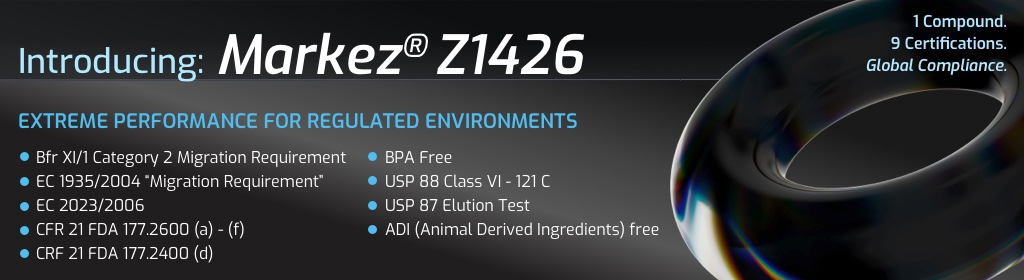
cleansing agents, and it is FDA-compliant and USP Class VI. Likewise, Markez® Z1426 is a high-purity compound
built to sanitary design standards. It resists strong acids, aggressive solvents, steam, and hot amines.
For a lower-cost middle ground, consider FKM or FEP-encapsulated O-rings. In addition, Marco offers sanitary
tri-clamp gaskets in compliant elastomers for process piping.
Elastomers Compatible With Steam Sterilization and Autoclave Cycles
Steam is harder on seals than dry heat. It hydrolyzes many polymers and causes hardening and cracking. As
a result, the best steam-resistant choices are:
- EPDM (peroxide-cured): the standard for steam-in-place (SIP) and autoclave service. Marco E1000 is rated
to 300°F (149°C). - Steam-resistant FKM: standard FKM performs poorly in steam. By contrast, Marco V1118 is a steam-
resistant terpolymer rated to 437°F (225°C). - Steam-grade FFKM: Markez Z1352 adds improved hot-amine and steam resistance. Meanwhile, Z1426
combines steam resistance with USP Class VI purity. - Silicone: works well for dry-heat sterilization and wide temperature swings. However, repeated high-
pressure steam shortens its life, so validate cycle counts.
O-Ring Materials That Are FDA Compliant for Medical Devices
Medical devices usually need two credentials. First, FDA compliance per 21 CFR 177.2600 covers material
ingredients. Second, USP Class VI testing under chapters <87> and <88> confirms biological reactivity. ISO
10993 may also apply for patient-contact devices.
Platinum-cured silicone is the most common choice for devices. For instance, Marco S1037 is cleanroom
manufactured and platinum-cured. For chemical or high-heat exposure, Markez Z1318 is a white FFKM that is
FDA compliant and USP Class VI. Markez Z1426, which is FDA compliant and USP Class VI, is designed for
high-purity environments. Alternatively, E1080 offers lower-cost steam and chemical resistance and is
manufactured to be USP Class VI, FDA compliant, and 3-A.
Elastomer Materials by Industry and Application
Visit our Complete Guide to Elastomer Seal Materials to consult our quick reference tables for typical temperature ranges and elastomer seal materials by application. Read on to find application-specific recommendations for other industries.
- Food and Beverage: O-Ring Materials Approved for Direct Food Contact
- Plasma-Resistant Seals and Elastomer Seal Materials for Semiconductor Fabs
- Elastomer Seal Materials for Oil & Gas: Subsea, Sour Gas, and Refinery Service
- Chemical-Resistant Seals for Aggressive Solvents in Chemical Processing
- Aerospace & Defense: MIL-SPEC O-Ring Materials for Fuel, Hydraulics, and Cold
- Elastomer Seal Materials for Automotive & Industrial Equipment

—
Related Reading
Standard O-Ring Size Charts
O-Ring Groove Design Guides
Custom Sealing Solutions – From Prototype to Production
Engineered Sealing Solutions: Your Questions About Custom O-Rings, Compounds & Assemblies, Answered