
Compliance touches nearly every part of the sealing industry today. From material sourcing to finished parts, regulations shape how manufacturers operate. Below, we break down what compliance really means, why it’s getting harder, and what to watch for next.
What Does “Compliance” Mean for Sealing Components?
At its core, compliance means products meet applicable standards and regulations. These may be industry-specific, international, or local. For rubber and plastics, that usually means understanding material composition. Manufacturers must confirm products meet requirements such as REACH, RoHS, and PFAS restrictions.
These rules serve three main purposes:
- Identify restricted substances
- Limit hazardous materials
- Reduce risk to customers, end users, and the environment
The Sealing Compliance Regulations Customers Ask About Most
Regulations keep expanding. As a result, more governments are following the lead of major regulators like the EU. The most common customer requests include:
- CA Prop 65 – requires warnings for products that may expose consumers to cancer or reproductive risks
- EU REACH – tracks substances of very high concern and requires disclosure above certain thresholds
- EU RoHS – limits hazardous chemicals in electrical and electronic applications
- PFAS – the persistent “forever chemicals” that don’t readily biodegrade and can pose health concerns
- TSCA – tracks new manufacturing chemicals and evaluates their potential risk
New requirements are also emerging. Because of this, manufacturers are seeing customer requests grow year over year.

Product-Level vs. Material-Level Sealing Compliance
Regulations can apply at both the product and material level. In some cases, they get extremely specific. For example, when a rule targets a particular chemical, compliance often depends on concentration. So, a rubber O-ring may meet heavy-metal limits even if the larger assembly doesn’t.
Other requirements focus on sourcing rather than composition. The EU Deforestation Regulation is one example. It requires certain products to be free from materials sourced from recently deforested land. Meanwhile, broader ESG requirements can apply across an entire company, including its internal practices, suppliers, and vendor relationships.
Why PFAS Has Become So Complicated
PFAS gained popularity because they resist heat, chemicals, and degradation. However, that same durability is now the concern. Because PFAS don’t readily break down, disposed products can build up in the environment over time. This can affect water, farmland, and communities.
PFAS are also hard for manufacturers to manage. They’ve been used in processes and materials for decades, while the associated risks became clear only recently. A key distinction matters here: by the time sealing products are sold, they’re typically considered “articles.” Therefore, they’re not generally viewed as posing the same leaching risk as raw chemicals. That said, most regulations don’t clearly account for this distinction, so the debate continues industry-wide.
Where Sealing Compliance Data Comes From
Most compliance information starts in the supply chain. So, manufacturers often need to work through their suppliers—and, in many cases, their raw material suppliers, too.
For instance, a customer may ask whether a specific O-ring compound meets REACH, RoHS, or PFAS requirements. Gathering accurate data can take time and involve several layers of follow-up. Once requirements are understood and supplier information is received, the declaration of conformity can be prepared and returned.
When a Supplier Doesn’t Believe a Rule Applies to Them
This is a common and difficult challenge. The EU often leads on new compliance requirements. However, those rules don’t automatically apply to suppliers outside the EU—unless customer or market pressure forces alignment.
The EU Packaging and Packaging Waste Regulation (PPWR) is a useful example. It applies to packaging for products entering the European market. So, EU customers expect evidence that packaging complies. To stay ahead, manufacturers may contact packaging suppliers early. Still, a supplier may respond that they don’t sell into the EU, so the regulation doesn’t apply to them.
That leaves the manufacturer in the middle. Customers may need compliant packaging, but the supplier may not provide it. At that point, there are two options:
- Evaluate alternative suppliers
- Rely on limited statements such as “to the best of our knowledge”
Neither is ideal, but the second is becoming more common.
Beyond the Part: Company-Level Compliance Requirements
Some requirements go beyond individual parts. PPWR, for example, focuses on packaging rather than the product itself. As a result, it can affect an entire company.
Customers may also ask about broader issues, including:
- CMRT/EMRT (conflict minerals reporting)
- EU POPs (persistent organic pollutants)
- EU MDR (medical device regulation)
These issues may seem less relevant domestically. Still, global sourcing makes supplier due diligence essential. Even trusted regions require visibility into where raw materials are mined, harvested, or processed.
Behind the Scenes: How a Compliance Request Gets Answered
So, what happens when a customer requests documentation? The process typically starts by confirming an existing business relationship, since requests sometimes come from unfamiliar companies.
From there, the steps generally include:
-
- Matching submitted parts to existing records
- Clarifying missing details with the customer
- Checking what compliance data is already on file
- Gathering missing information through the supply chain
- Preparing and sending declarations
- Saving documentation for future cross-reference
For O-rings, many declarations are ready in advance. That’s because they’re based on compound rather than size.

Why Sealing Compliance Is So Challenging Right Now
The issue isn’t that the industry is over-regulated. Instead, many regulations are difficult to apply consistently across complex supply chains.
The PPWR example illustrates this well. A requirement may apply to the customer or end market, but not directly to every supplier involved. This leaves manufacturers and distributors responsible for compliance—without always having a clear way to obtain the needed information.
PFAS creates a similar challenge. Sealing products such as O-rings are generally considered “articles.” Therefore, they aren’t typically viewed as presenting the same risk as raw chemicals or liquid formulations. Still, many regulations don’t clearly reflect that distinction. Because of this, suppliers may be reluctant to invest time gathering data, especially when requirements feel unclear or overly broad.
Ultimately, stronger alignment between regulations, supply-chain responsibility, and practical product risk would help everyone involved.
What to Watch For in Sealing Compliance Going Forward
In the U.S., compliance is shifting from federal action toward state-level requirements. This can create a patchwork of overlapping rules.
PFAS is a good example:
- Minnesota’s requirements apply to products made or sold in the state
- New Mexico’s upcoming law adds labeling requirements for products sold there
As a result, a single order could involve multiple PFAS obligations across different jurisdictions. Each may carry its own documentation or reporting expectations.
The intent behind these rules is important—protecting consumers and the environment. However, the lack of consistency creates unnecessary complexity for manufacturers, distributors, and customers alike. Looking ahead, strong supply-chain visibility and clear compliance processes will be essential.
Compliance You Can Count On
Quality and compliance sit at the center of everything Marco Sealing Solutions does. Our Quality Management System (QMS) is ISO 9001:2015 Certified by NQA, demonstrating our dedication to continuous improvement, innovative and adaptive leadership, evidence-based decision-making, and top-of-the-line quality management. This commitment carries through every material, certification, and declaration we provide—so customers can source with confidence. Have a compliance-related project or question? Contact Marco Sealing Solutions today, and our team will help you find the right sealing solution for your application.
Frequently Asked Questions About Sealing Compliance
What o-ring materials are FDA compliant for use in medical devices?
Several FDA-approved elastomers are available for medical device seals, including FDA-grade Buna-N, EPDM, Silicone, Viton®, Kalrez®, and Markez® FFKM. These medical-grade sealing materials are compounded from ingredients the FDA has found to be neither toxic nor carcinogenic under CFR 21.177.2600.
That said, FDA compliance is a manufacturer claim, not an FDA approval. So, proper O-ring material selection also requires a manufacturer’s compliance certificate. A material being FDA compliant doesn’t automatically mean it’s suitable for a specific application—the design still needs validation for the intended use. Marco has engineers on staff to assist with validation for your FDA compliance needs.
What traceability documentation is available for o-rings used in medical device manufacturing?
O-ring material traceability typically includes lot or batch numbers tied to specific compound records. This supports manufacturing documentation and quality assurance records throughout a part’s life cycle.
For medical-grade seals, regulatory compliance documentation generally includes:
- Certificates of compliance or conformity
- Material compound and batch data
- FDA, USP Class VI, or other applicable certifications
Because lot and batch traceability matters most during returns or investigations, products should be isolated by lot. Mixing lots can compromise traceability and affect eligibility for returns.
Which o-ring distributors provide compound validation data and chemical compatibility reports?
Distributors with deep material expertise, such as Marco Sealing Solutions, offer chemical compatibility charts covering thousands of fluids and chemical types across common O-ring compounds. However, generalized chemical resistance data is based on isolated testing in optimal, room-temperature conditions.
Therefore, real-world performance depends on additional factors, including:
- Temperature and pressure
- Gland design
- Exposure time and concentration
- Specific compound formulation
Because of these variables, it’s best to work with an application engineer to validate a compound before committing to production.
How do I validate a new o-ring compound for a PFAS-free semiconductor process seal?
Semiconductor environments are among the harshest applications for chemical-resistant elastomers. Processes can include high heat, aggressive plasma, hot wet chemicals, amines, and remote NF3 cleans.
Marco offers materials such as fluorosilicone (FVMQ), Viton® FKM, and perfluoroelastomers (FFKM) built for semiconductor equipment seals. To validate a new compound, we recommend:
- Defining the exact process chemistry and temperature range
- Reviewing chemical compatibility data for candidate compounds
- Requesting material certifications and PPAP documentation
- Running application-specific testing before full qualification
Because semiconductor programs often move fast, Marco offers custom molded seals and short lead-time o-rings which can help keep validation on schedule.
Who supplies USP CL VI o-rings?
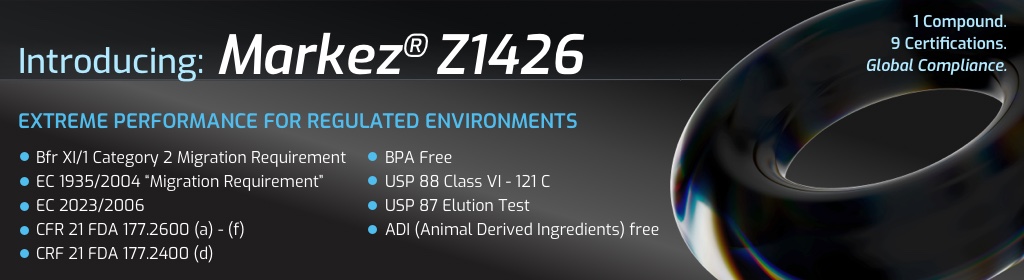
USP Class VI o-rings are available from Marco Sealing Solutions, as well as other suppliers such as Global O-Ring and Seal, who offer FDA-compliant o-rings and medical-grade seals across multiple elastomeric sealing products. USP Class VI is a stricter standard than general FDA compliance. It addresses systemic and intracutaneous toxicity for critical medical applications.
USP Class VI certified o-rings are typically available in:
These compounds are made from ingredients with a documented history of biocompatibility. As a result, they meet tighter leachate requirements than standard food- or industrial-grade materials.
What sealing solutions meet MIL-SPEC requirements for aerospace hydraulic systems?
Aerospace sealing solutions for hydraulic system seals generally reference AS568 dimensional standards, which set tighter tolerances than general-purpose O-rings. These tolerances typically align with most military specification seals.
Common material options for MIL-SPEC aerospace hydraulic seal applications include:
- Fluorosilicone (FVMQ) for aerospace fuel seals
- Nitrile (Buna-N) rated for Mil-Spec temperature ranges
- Perfluoroelastomers for extreme chemical and thermal environments
Because aviation seals must perform reliably under extreme pressure and temperature swings, suppliers with mil-spec reference charts and QPL listings make material selection easier for these high-performance sealing components.
Who can supply 3A Sanitary O-rings?
3-A Sanitary Standards were formed by the U.S. food and dairy industry. Like FDA standards, they’re adopted worldwide. Materials commonly available in 3-A compliant formulas include EPDM, Viton® FKM, and perfluoroelastomer compounds.
An added consideration: some 3-A materials are also free from animal-derived ingredients (ADI-free), which matters for certain dairy and pharmaceutical applications. Suppliers such as Marco Sealing Solutions, which offers 3-A-compliant O-rings, also stock the same materials in FDA and USP Class VI grades, since dairy and food equipment often needs to satisfy multiple standards at once.
What o-ring materials are approved for direct food contact applications?
FDA-approved O-rings for direct food contact applications are compounded entirely from ingredients on the FDA’s approved list, then tested for extraction limits in water and n-hexane. Common food-grade O-ring materials include Buna-N, EPDM, Silicone, Viton® FKM, and Markez® FFKM. Marco supplies FDA-approved standard O-rings and seals as well as custom sealing solutions.
For food-safe sealing materials, additional certifications often layer on top of FDA compliance, including:
- NSF-61 for drinking water contact
- 3-A for dairy processing
- USP Class VI for pharmaceutical-adjacent applications
Because sanitary seals face repeated washdowns and cleaning chemicals, elastomer selection should also weigh resistance to detergents, steam, and CIP (clean-in-place) cycles—not just food contact approval alone.

—
Related Reading
Sealing Solutions for the Regulatory Requirements of the Medical Sector
Purity and Regulatory Compliance for Drinking Water Applications
FDA Approved Sealing Solutions
MIL Spec Compounds
3A Sanitary Standards Compliant Sealing Solutions
Understanding PPAP (Production Part Approval Process)