
What Is PPAP?
PPAP stands for Production Part Approval Process. It is a document package that provides reassurance to customers that Marco Sealing Solutions understands their requirements and is able to meet them.
PPAP is an industry standard that originated in automotive and aerospace. However, it is a tool that can be used by any end user in any industry.
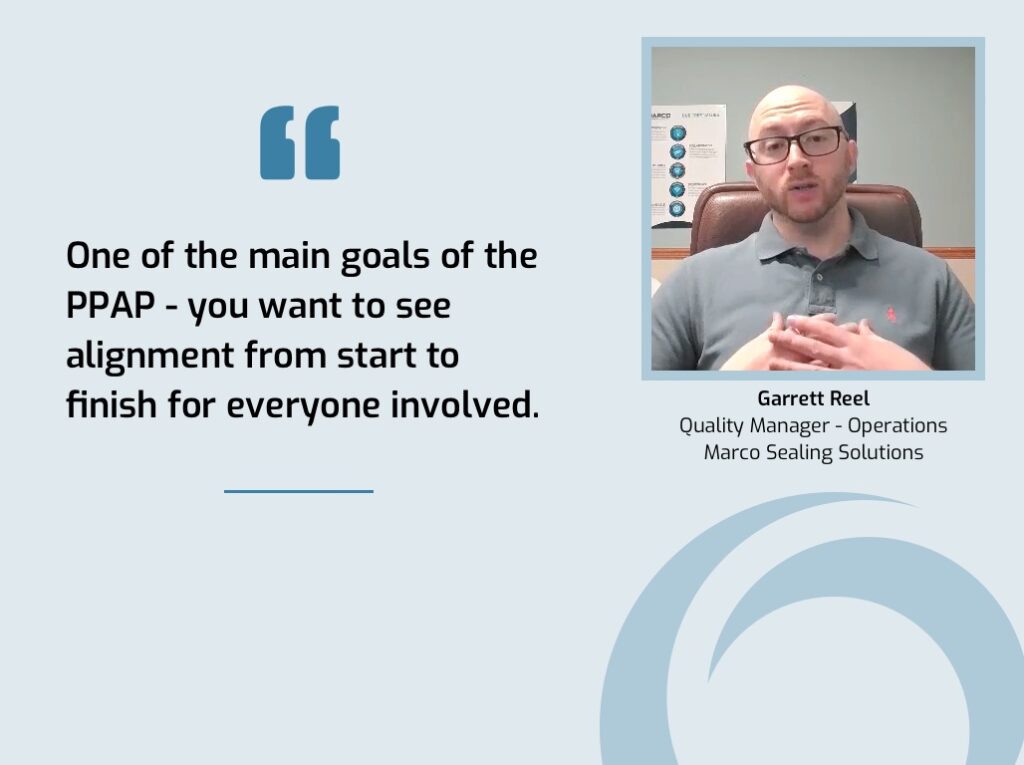
The core purpose of a PPAP is to establish confidence and alignment between the supplier and the customer before production begins. It is not just paperwork. It is evidence that everyone involved understands the product, the process, and the requirements.

Why Does PPAP Matter?
Not every supplier can provide a PPAP. The ability to deliver one signals a higher level of capability and quality rigor. For Marco, PPAP is a competitive differentiator.
Here is what a PPAP accomplishes:
- Reduces risk of defects and quality issues by ensuring alignment before production starts
- Confirms that Marco and the factory understand every requirement for the finished part and any process it will go through
- Builds trust and assurance in the production process
- Creates a documented record that can be passed along through the supply chain, including to aerospace and automotive end users
- Strengthens long-term supplier relationships and customer confidence

When Is PPAP Required?
The customer always determines whether a PPAP is required. Marco will never tell a customer they need one, though the team may suggest it to create further alignment. Common triggers include:
- Launch of a new product or part
- Introduction of new tooling
- Revision changes to a part that was previously approved through PPAP
- A change in the production facility location
- A customer request at any time, including for parts that have been in production for years
Important note: A PPAP is not required for every order. Once a PPAP is approved and nothing changes, production continues under that approval. But if the customer changes their requirements or wants additional security, they can request a new one, even for legacy parts with a long production history.
PPAP Submission Levels
There are five PPAP submission levels. Level 3 is the most common and is considered the industry standard. Each level builds on the one before it.
-
- Part Submission Warrant Only – The Part Submission Warrant (PSW) alone. Details tooling method, run rates, and serves as the sign-off document for both sides. Used when the customer already has the goods.
- PSW + Limited Data – PSW plus limited supporting data such as a certificate of conformance, dimensional reports, or physical samples.
- Full PPAP Package (Standard) – The bread and butter. PSW, dimensional reports, statistical analysis, and material compliance data. Satisfies 99% of customer requirements. This is what Marco produces by default.
- Level 3 + Customer-Specific Requirements – Everything in Level 3 plus any additional documents the customer requires specific to their product or part line. This is where requirements become a la carte.
- Full Package + On-Site Audit – All of the above plus a physical audit of the production facility. The customer comes to the factory to review all documented processes in person. This level is rare.
Core Elements of a Level 3 PPAP Package
A complete Level 3 PPAP contains the following documents. Each one serves a specific function in validating that the part and process meet customer requirements.
1. Part Submission Warrant (PSW)
The foundational document present in every PPAP level. Details the part number, the referenced drawing, tooling cavities, run rates, and other critical information. The PSW is signed by both Marco and the customer. A signed PSW returned to Marco represents formal customer approval.
2. Design Record
Confirms agreement to the current revision level of the part drawing. Documents any specific engineering changes that may impact the end product.
3. PFMEA (Process Failure Mode and Effects Analysis)
Developed by the production team. This analysis works through what happens if something goes wrong. For example: What is the impact if the wrong material is used? What if the wrong measuring tools are applied? The PFMEA fail-proofs the process and documents the corrective steps for each potential failure.
4. Control Plan
An outline of every step in the production process from start to finish. Shows exactly how the production facility handles each stage of manufacturing.
5. MSA (Measurement System Analysis) / Gauge R&R
An analysis of the reliability and repeatability of the factory’s measurement tools and methods. In practice, this can look like three different engineers measuring the same parts with the same tools and recording their results independently. This reveals how reliable the gauges and testing methodology are.
6. Dimensional Results
Measurements taken on all dimensions specified in the drawing. Every specified dimension must be measured and confirmed as meeting requirements.
7. Material and Performance Testing
May include a standard spec sheet or additional test results based on what the print requires. For example, if a part must be exposed to ozone, the PPAP includes documentation of how the part performs under those conditions.
8. Process Capability Studies (CPK)
A statistical review of a critical dimension. The factory measures that dimension repeatedly and analyzes how reliably the tool holds that dimension within the expected tolerance range. Customers sometimes specify a minimum CPK value they will accept.
9. Physical Parts / Samples
In almost every case, Marco sends physical samples from the tool so the customer can measure and test them independently. Having samples approved by the customer is a critical component of the PPAP.
The PPAP Process: Start to Finish
A PPAP follows a defined sequence. The goal throughout is alignment: ensuring everyone from Marco to the factory to the customer is working from the same understanding.
- Quoting and Requirements Gathering. The Marco team collects all the information the customer can provide during the quoting stage. This is fed to internal teams and the production facility to ensure everyone is aligned from the start.
- Design and Process Review. The factory reviews the requirements and confirms it understands the customer’s needs and has the capability to meet them.
- Documentation Development. The factory develops the process flow, control plans, and other required documentation.
- Tooling Development and Initial Production. The tooling is built and the first batch of parts is produced.
- Validation. Parts are measured. CPK data is collected. Gauge R&R is conducted. Raw material is validated. Parts are tested to customer specifications.
- Package Assembly and Submission. All documents are compiled into the PPAP package and submitted to Marco, who reviews it and submits to the customer.
- Customer Approval. The customer reviews the package and returns a signed PSW. This signed PSW is formal approval to begin production.
PPAP for Molded Parts: Key Considerations
When a PPAP involves molded rubber or elastomeric components, there are specific parameters that are critical to validate:
- Tooling and material alignment: The tool must be specifically designed for the material being used. Different materials have different shrink rates. You cannot run different materials through the same tool and expect consistent results.
- Temperature and cure times: These must be precisely set for the specific material to produce the part the customer expects.
- Pressure control: Molding pressure must be within spec.
- Raw material traceability: If a problem arises with a finished part, there must be a documented path back to the specific raw material batch used.
- Cavity identification: For multi-cavity tools, each cavity is identified so that dimensional issues can be traced to a specific cavity. For example, if only cavities 40 through 50 in a 160-cavity tool are producing out-of-tolerance parts, cavity identification tells the team exactly where to look.
- Tooling maintenance: Dimensional stability is tied directly to the condition of the tooling. Parts that are perfectly in spec in the first run may drift over time as the tool wears. Ongoing tooling maintenance is critical, and a tool that has been repeatedly repaired may eventually require replacement, which can trigger a new PPAP.
- Flash control: Tool design can minimize flash, and secondary processes such as cryogenic deflashing can be used to remove any excess material.
Common PPAP Challenges
These are the issues that come up most often. Understanding them helps the sales team ask the right questions early and set accurate expectations with customers.
Misalignment Between Customer Requirements and Factory Understanding
This is the most frequent challenge. If the factory does not fully understand what the customer needs, the PPAP will not pass on the first submission. This is why Marco places so much emphasis on extracting complete requirements during the quoting stage.
Missing or Incorrect Documents
A PPAP package contains many documents, including calibration data for all measurement equipment used at the factory level. It is easy to miss something. Every piece must be reviewed carefully before submission.
CPK Values Outside of Customer Acceptance Range
A part can measure in tolerance on every individual measurement and still fail CPK. If the parts show wide variation within the tolerance band, the CPK number may be too low for the customer to accept. This signals a need to go back, remeasure, review the tooling, and bring the dimensions more tightly centered. Parts that are barely acceptable now will only get worse over time.
Customer-Specific Templates
Larger customers sometimes require all PPAP documentation to be completed on their own proprietary templates. This can mean either providing that template to the factory or manually transposing factory-supplied data into the customer format. If the customer template is more detailed than the standard PPAP document, this requires careful review to make sure all required fields are complete.

PPAP Best Practices and Preparation Checklist
The following practices help keep the PPAP process moving smoothly and reduce the risk of delays or failed submissions:
- Use a checklist for every submission. A Level 3 PPAP has a standard document checklist. Each of those documents may have its own internal checklist.
- Communicate early in the quoting process. Ask the customer about any specific requirements before the PPAP begins, not after.
- Communicate engineering changes immediately. If the customer changes the design or engineering requirements mid-process, those changes must be relayed to the production team right away.
- Retain master samples. The Marco Florida office retains master samples from all first articles and new production samples. Both Marco and the customer should have approved master samples on file for reference.
- Store documents accessibly. PSWs, PPAPs, and all related documents should be organized and retrievable by all relevant parties at any time.
- Invest in ongoing training. Understanding the levels, the acronyms, and the process allows the team to have better conversations with customers and factories, and to catch issues before they become problems.
Glossary of Key PPAP Terms
PPAP: Production Part Approval Process. A document package that confirms supplier capability and customer alignment before production begins.
PSW: Part Submission Warrant. The core document of every PPAP, signed by both supplier and customer to formally approve the part and process.
PFMEA: Process Failure Mode and Effects Analysis. A document that identifies what could go wrong in the production process and defines corrective steps for each scenario.
Control Plan: A document outlining every step in the production process, showing how each stage is managed and monitored.
MSA: Measurement System Analysis. An evaluation of the accuracy and reliability of the measurement tools and methods used at the factory.
Gauge R&R: Gauge Repeatability and Reproducibility. A measurement study in which multiple operators measure the same parts with the same tools to evaluate consistency.
CPK: Process Capability Index. A statistical measure of how reliably a process holds a critical dimension within its tolerance range. A higher CPK indicates more consistent, centered production.
First Article: The initial parts produced from a new tool, submitted for inspection and approval before full production begins.
Cavity Identification: A system for marking each cavity in a multi-cavity tool so that dimensional issues can be traced to a specific cavity.
Cryogenic Deflashing: A secondary process in which parts are treated at low temperatures to remove excess material (flash) from molded rubber components.
Frequently Asked Questions
Does every order require a PPAP?
No. A PPAP is a one-time approval for a specific part, process, and tooling configuration. Once approved, production continues under that approval unless something changes.
Who decides if a PPAP is needed?
Always the customer. Marco may suggest one when it would benefit alignment, but the customer makes the final call.
Can a customer request a PPAP on a part we have been producing for years?
Yes. Customers can request a new PPAP at any time, including for legacy parts with long production histories. This often happens when their own requirements change or they want additional assurance.
What level of PPAP does Marco typically provide?
Level 3 is the standard. It covers the full document package and satisfies the requirements of most customers.
What does a signed PSW mean?
A signed Part Submission Warrant from the customer is formal approval of the part and production process. It means production can begin.
What happens if the PPAP is not approved?
The package is returned with feedback. Marco works with the factory to address the gaps, whether that means re-measuring parts, reviewing tooling, or providing missing documents, and resubmits.
Can a customer require their own template?
Yes. Some larger customers require all PPAP documentation to be completed on their specific format. Marco handles the transposing of data into that format when needed.
Why does a new tool require a new PPAP?
A new tool has different dimensional characteristics than the old one. Even if it produces the same part, the customer needs assurance that the new tool meets the same standards as the one that was previously approved.