The Challenge
A food and beverage company approached Marco Sealing Solutions (Formerly Marco Rubber & Plastics). They needed a custom rubber solution for automation. The part would work in a fresh produce processing facility. Specifically, this part picked and applied stickers to fruit. The fruit moved constantly through the production line. The client needed to improve the consistency and service life of the mechanism. Therefore, the project’s success hinged on solving several pain points.
First and foremost, the material formulation was essential. FDA-compliant material was a requirement. The machine creates a vacuum force through the part to pick up the sticker. Then, it releases the pressure to place the sticker on the fruit. Afterwards, the part must return to its original shape. Furthermore, the part performs this action continuously in a 24/7 production environment. Because of this, the material requires high tensile strength, elongation resistance, and abrasion resistance.
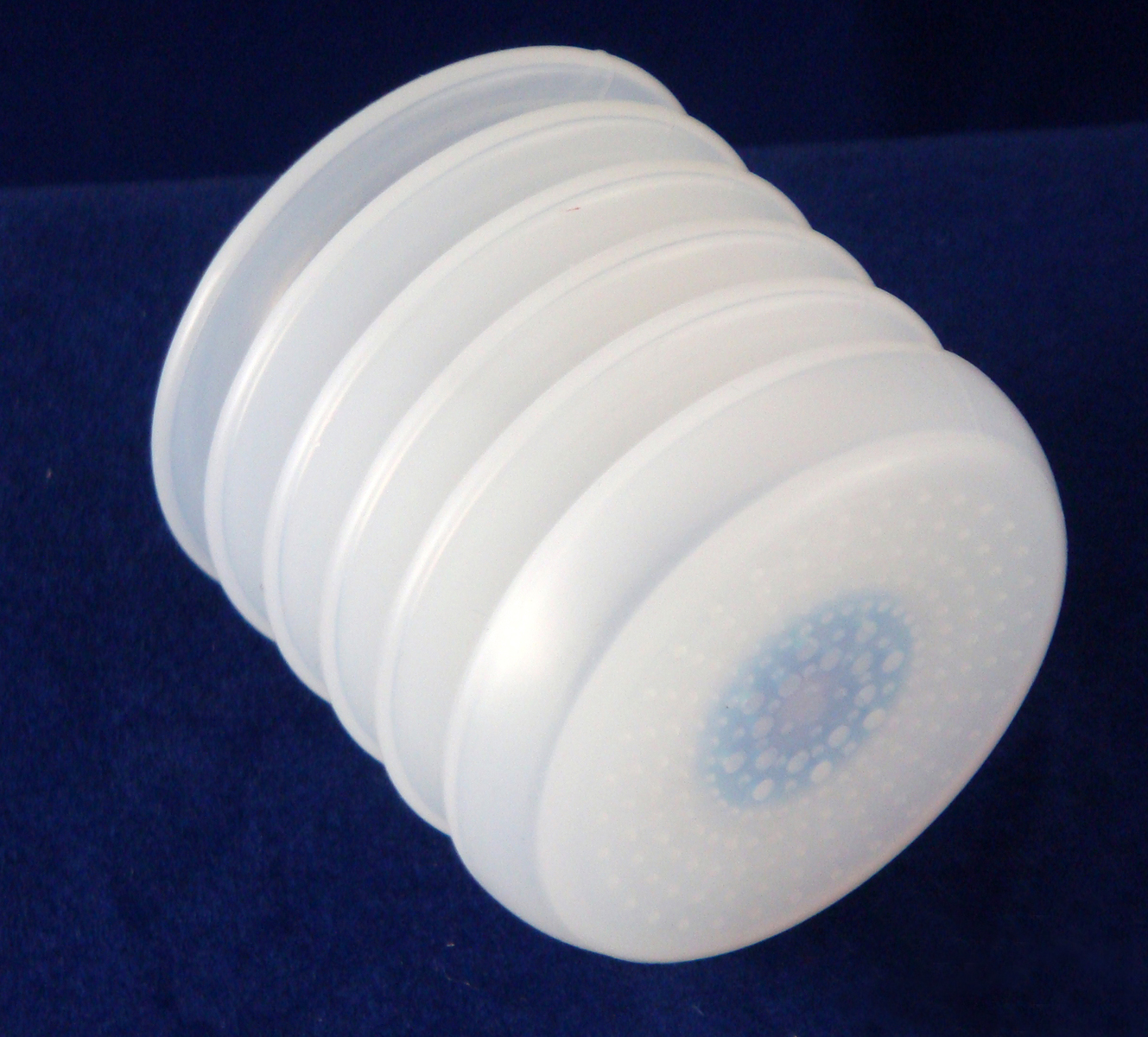
The textured face of the part grabs, holds, and releases the sticker when the vacuum changes. Consequently, the textured face demanded a tight tolerance to specifications. Additionally, the ribs or grooves on the textured face demanded fine tolerance. Otherwise, the part would fail to accept or place stickers properly.
Lastly, the interior check valve or ‘flapper’ turns the vacuum pressure on and off. This element also requires high tolerance to specs. Without exact tolerances, the machine could not reliably produce the required pressure to handle the sticker.
The Solution
Marco’s engineering team designed a custom rubber solution for automation. They incorporated a bellows-like, accordion-shaped part. This specific design executes the repeated vacuum pressure the application requires.
The team used FDA-grade translucent silicone for the bulk of the part. As a result, the material holds up well to constant, repeated use. And, it meets all necessary requirements for the food and beverage industry. Additionally, this silicone allowed the engineers to easily achieve the tight tolerances for the textured face element.
The engineers chose FDA-grade blue silicone for the interior ‘flapper’ mechanism. This color difference makes the specific component easy to identify. This blue material also meets the strict food industry requirements. Furthermore, it provides ease of use when working to exact specifications.
Ultimately, the team delivered a small-to-midsize part that serves the application perfectly, despite heavy use.
The Result
The newly designed part delivered on all expectations. It provided increasingly consistent suction. Consequently, the client saw fewer sticker application failures. The materials offered improved abrasion resistance, tensile strength, and elongation resistance. As a result, the service life increased by 25% for each suction sticker component.
Because the machine required fewer replacement parts, the produce company experienced significantly less downtime. This improvement is vital. Any shutdown costs a production facility an exponential amount of money. Furthermore, expenses increase when dealing with products with a short shelf life, such as fruit.
This type of custom rubber solution for automation is applicable across many industries. It certainly extends beyond food and beverage. For instance, companies that use suction or vacuum automation to place labels and bottles. Television manufacturers also use similar mechanics to place screens. This type of solution can be valuable in any facility using minimally invasive pick-and-place methodology to move products from one stage to another.
Learn how our engineering expertise can help with your custom rubber solutions for automation, effective sealing, and more. Contact Marco Sealing Solutions today.