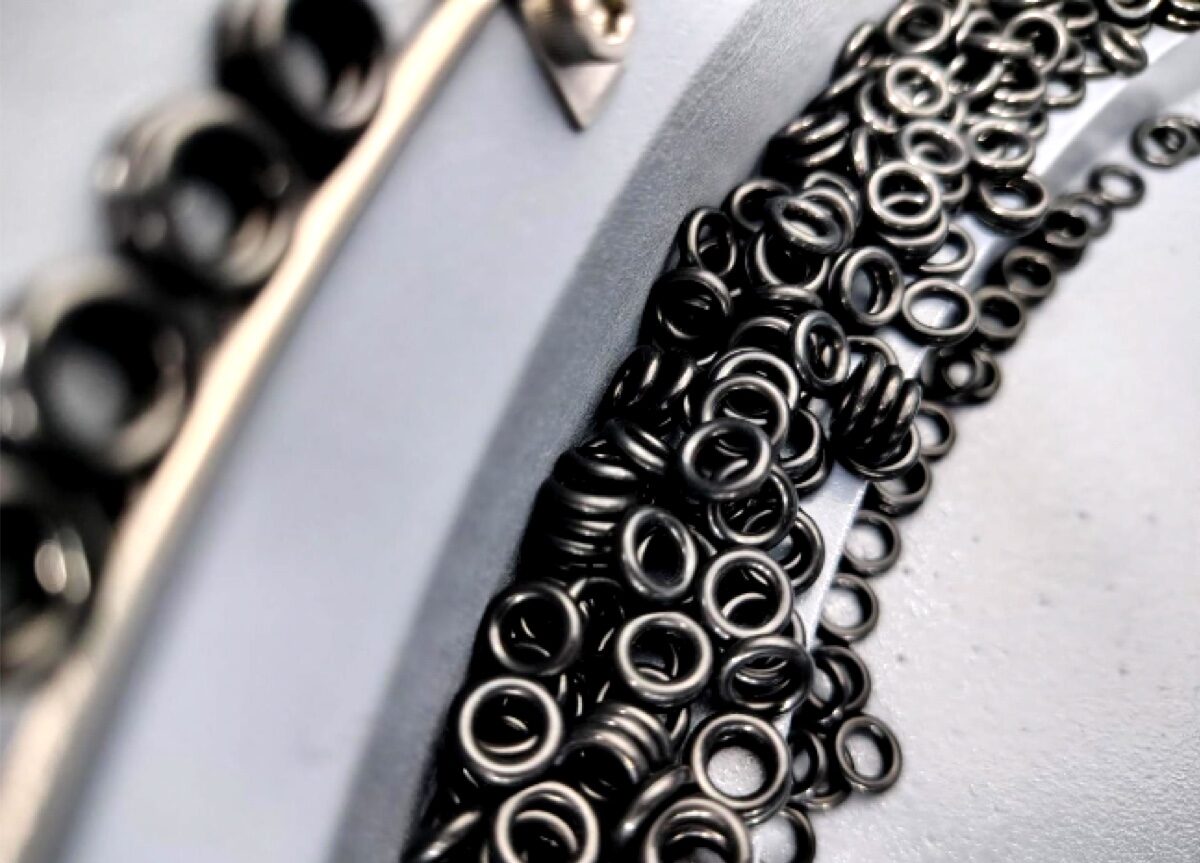
Small changes in an o-ring’s finish can affect how it moves through automated equipment. In vibration-bowl applications, a shiny finish can cause o-rings to clump together rather than separate and feed consistently. Addressing the issue in the vibration bowl during automation required a controlled and repeatable matte finish.
The Challenge:
Reducing O-Ring Clumping in Vibration Bowl Automation
A medical components manufacturer contacted Marco after its o-rings began clumping inside a vibration bowl. This issue resulted in frequent stoppage of the automated vibratory feeder. These stoppages slowed production, required additional operator attention, and reduced process efficiency.
The Solution:
Adjusting Surface Finish for Vibration Bowl Automation
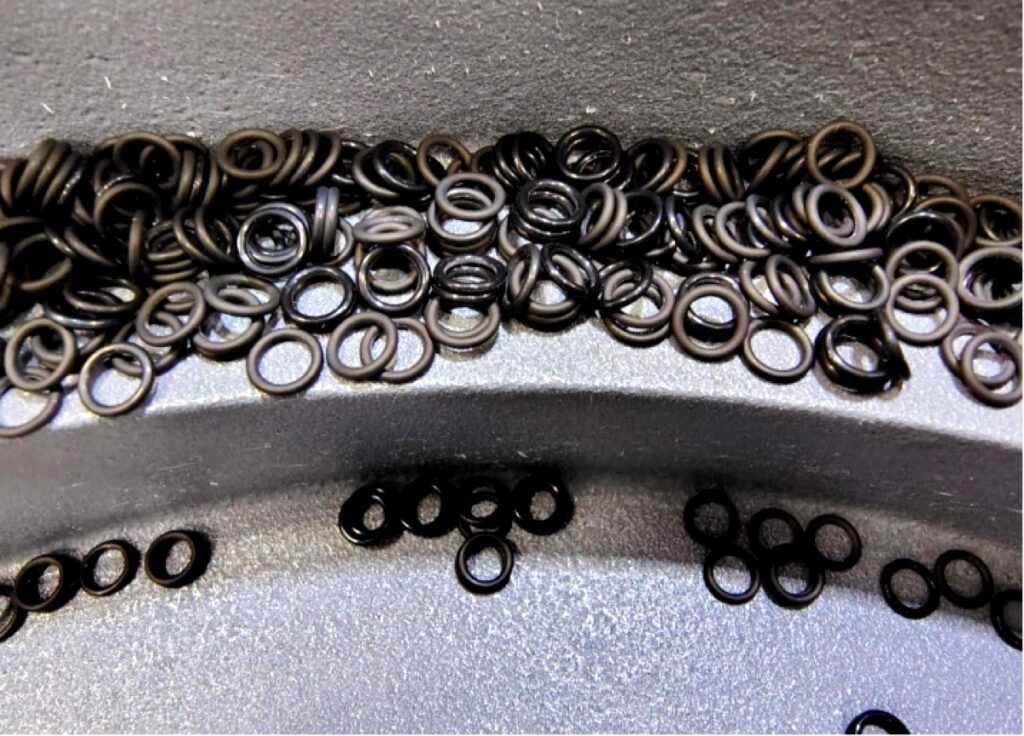
Marco’s team of experts identified the cause of the problem in the vibration bowl. Because a shiny or polished o-ring is extremely smooth at a microscopic level, when it is pressed against a flat mating surface, the physical contact area between the rubber and the metal/plastic is maximized.
This high contact area creates strong intermolecular attractive forces (van der Waals forces), allowing the rubber to essentially “suction” or bond to the surface. In other words, the o-rings’ shiny surface finish caused them to clump in the vibration bowl. Therefore, the solution was to adjust the surface finish to create less surface area. Less surface area creates less static, which eliminates clumping.
Marco’s Engineering Approach
Marco’s team of experts set out to find a customized solution to deliver a consistent matte finish. This would improve how the o-rings move through the process.
Marco initially arranged for the existing o-rings to be tumbled to reduce the shine. However, due to screening limitations and the small size of the o-rings, approximately 50% of the parts remained shiny after tumbling.
Marco’s team then conducted an on-site visit to observe the customer’s process and gather additional information about the application. The team discussed tumbling the parts after production with multiple vendors. Most vendors were reluctant to pursue this approach or were unable to commit to a surface-finish callout.
After observing the customer’s process on-site, Marco worked with multiple suppliers to find a production method that could consistently meet a specific surface-finish requirement. The team ultimately identified a manufacturing partner who could produce custom tooling with a matte finish of approximately 1.6–2.4 microns.
With the initial order, the supplier would measure the production parts with a profilometer and report the surface finish. This process would provide a measurable approach to evaluating the matte finish of the production parts. To follow up, Marco’s team continues to work with the customer to evaluate the surface finish of the production parts and gather feedback on the matte finish.
Proven Results: Improving Vibration Bowl Performance with a Controlled Matte Finish
Marco developed a custom tool designed to create a controlled, repeatable matte finish with a surface roughness of approximately 1.6–2.4 microns. The finish was measured and documented using a profilometer to help ensure consistent results. By reducing the tendency of the o-rings to clump inside the vibration bowl, the solution will support steadier output, fewer equipment stoppages, and lower overall production costs for the customer.
After the initial production order, the customer will evaluate the finished parts and provide feedback. Marco will continue working with the customer to determine whether three additional tools could further improve and support their production.
Reliable Solutions for Medical Manufacturing
In medical and pharmaceutical equipment, even an o-ring’s surface finish can affect production efficiency. For precise, repeatable assembly, Marco Sealing Solutions provides engineering support to evaluate component handling, surface finish, and application-specific requirements.
Through detailed analysis and testing, Marco helps manufacturers identify solutions that improve component handling. A more controlled and repeatable matte finish provided smoother o-ring separation, steadier output, fewer equipment stoppages, and a more efficient automated process.
Contact Marco Sealing Solutions for expert engineering support, o-ring sizing, groove design, and more.